
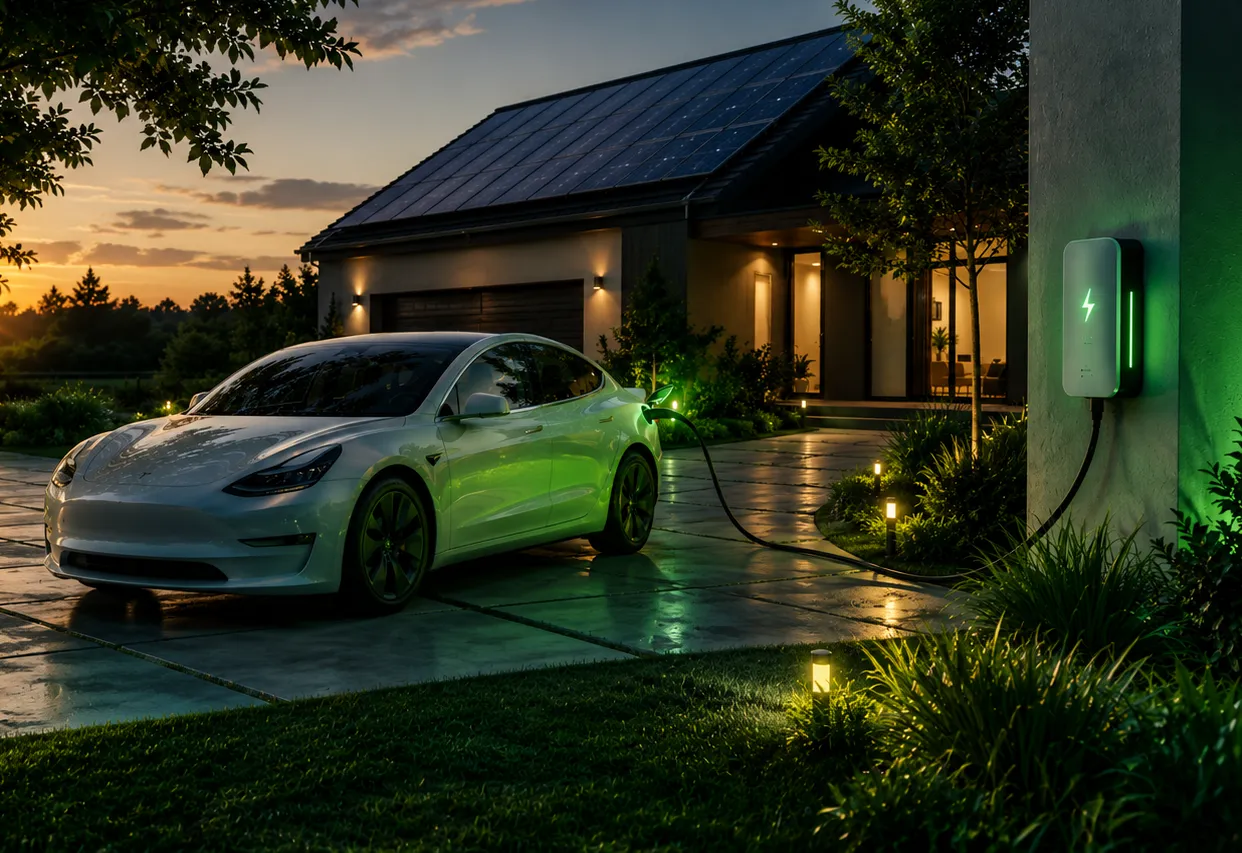
How Electric Cars Actually Work
A battery electric vehicle replaces a gasoline engine with three core components: a battery pack, a power inverter, and an electric motor. That's it. No combustion, no transmission with dozens of gear ratios, no exhaust system. The simplicity is one of the main reasons EVs cost so much less to maintain over time.
The Battery Pack
The battery pack — typically mounted flat under the floor, which lowers the center of gravity and improves handling — stores all the energy that powers the vehicle. Most 2026 EVs carry 60–100+ kWh of capacity, giving 200–350 miles of real-world range. A battery management system (BMS) continuously monitors cell temperature, voltage, and charge balance to protect longevity and performance.
The Electric Motor
Electric motors convert electrical energy to motion at roughly 85–92% efficiency. A gasoline engine manages 20–35% — the rest escapes as heat through the exhaust and cooling system. This efficiency gap is why electricity costs 3–4x less per mile than gasoline for the same distance traveled.
Electric motors also deliver maximum torque instantly from 0 RPM. There's no waiting for the engine to rev up, no gear shifts, no turbo lag. A base-model Chevy Equinox EV accelerates faster than most V6 gas cars. A Tesla Model 3 Performance hits 60 mph in 3.1 seconds.
Regenerative Braking
When you lift off the accelerator or press the brake pedal, the motor reverses function and becomes a generator. Your vehicle's forward momentum gets converted back into electricity and stored in the battery. Regenerative braking recovers 60–70% of kinetic energy that would otherwise be wasted as heat in traditional brake pads — and it dramatically extends brake pad life. Many EV owners go 100,000+ miles before their first brake service.
The Three Types of Electric Vehicles
Not all "electric vehicles" are the same. Understanding the differences helps you choose what actually fits your life.
Battery Electric Vehicle
100% electric, no gas engine
Runs entirely on battery power. Zero tailpipe emissions. You charge at home overnight and rarely think about fuel again. Range: 200–350+ miles per charge on most 2026 models.
Examples: Tesla Model 3/Y, Chevy Equinox EV, Hyundai Ioniq 6, Ford Mustang Mach-E, Rivian R1T
Best for: Most drivers with access to home charging. If you drive under 200 miles per day 95% of the time, a BEV works perfectly.
Plug-In Hybrid
Electric + gas backup
Has both a plug-in battery (20–50 miles electric range) and a gas engine. Use electricity for daily driving, gas for long trips. No range anxiety.
Examples: Toyota RAV4 Prime, Ford Escape PHEV, Jeep Wrangler 4xe, Chrysler Pacifica PHEV
Best for: Drivers who regularly take 300+ mile trips but want electric efficiency for daily commuting. A good transition vehicle.
Conventional Hybrid
Better MPG, can't plug in
Combines gas and electric, but charges only through regenerative braking — no plug-in charging. No behavior change required. Just better fuel economy.
Examples: Toyota Prius, Honda Accord Hybrid, Toyota Camry Hybrid
Best for: Drivers who want lower fuel costs with zero lifestyle change. Not technically an "EV" — no charging infrastructure needed.
EV Charging Levels Explained
The charging question is the one new EV owners think about most before buying — and stop thinking about shortly after. Here's how the three levels work in practice.
Level 1 — Standard 120V Outlet
3–5 miles of range per hour
Plug directly into any standard household outlet. No equipment needed — every EV comes with a Level 1 cable. Adds roughly 40 miles overnight (8 hours). Sufficient for PHEVs and low-mileage BEV drivers. Too slow for daily full charging of a long-range EV.
Cost: $0 equipment. Roughly $0.03–0.05/mile in electricity.
Level 2 — Home Wall Charger (Most Popular)
20–30 miles of range per hour
A 240V charger installed in your garage or carport. Fully charges most EVs in 6–10 hours — overnight while you sleep. This is what the vast majority of EV owners use for 90% of their charging. You leave with a full battery every morning.
Equipment cost: $300–$700 for the charger unit. $500–$1,200 for professional electrical installation. Total: $800–$1,900. A federal tax credit covers 30% of this cost (up to $1,000).
Popular chargers: ChargePoint Home Flex ($699), Grizzl-E Classic ($399), Tesla Wall Connector ($475 for non-Tesla compatible)
DC Fast Charging — Public Highway Charging
100–250 miles of range in 20–45 minutes
High-power public charging stations found at highway rest stops, retail centers, and dedicated charging hubs. Used primarily for road trips — not daily charging. Tesla Superchargers, Electrify America, EVgo, and ChargePoint operate the major networks. Cost varies: $0.25–$0.55/kWh typically.
Note: Frequent DC fast charging (daily) accelerates battery degradation slightly. Fine for occasional road trips — not intended as your primary charging method.
Real EV vs Gas Cost Comparison
The purchase price of an EV is often higher than a comparable gas vehicle — but total cost of ownership over 5–7 years frequently favors the EV significantly. Here's an honest breakdown:
The average EV owner saves $1,500–$2,500 per year on fuel and maintenance combined. Over 7 years, that's $10,500–$17,500 in savings — enough to offset a significant portion of any purchase price premium. Use our EV Savings Calculator to see your specific numbers based on your driving habits and local electricity rates.
How Much Do You Save on Fuel?
The average American drives about 15,000 miles per year. At current gas prices and efficiency averages:
- Gas car at 28 MPG + $3.50/gallon: $1,875/year in fuel
- EV at 3.5 miles/kWh + $0.15/kWh: $643/year in electricity
- Annual savings: ~$1,232
If you charge with rooftop solar at home — where your electricity cost approaches $0/kWh — the savings jump to roughly $1,875 per year in fuel costs alone. This is one of the strongest financial arguments for combining solar panels with an EV.
Setting Up Home EV Charging
Most EV owners install a Level 2 charger in their garage or on an exterior wall. The process is straightforward:
Electric Vehicle FAQs
How far can an EV go on a single charge?
Most 2026 EVs offer 220–350 miles of EPA-rated range. Real-world range is typically 85–90% of that EPA figure in moderate temperatures. Cold weather (below 20°F) can reduce range by 20–40% — a significant consideration in northern states. Highway driving at 75+ mph also uses more energy than city driving, reducing range by 15–20% compared to EPA estimates, which are primarily city/suburban driving cycles.
How long does it take to charge an EV?
It depends on the charger level. Level 1 (120V standard outlet): 40–50 miles overnight, or a full week to charge a depleted 70 kWh battery from empty. Level 2 (home wall charger): full charge in 6–10 hours depending on battery size and charger amperage — most people wake up to a full battery every day. DC fast charging: 80% charge in 20–45 minutes for most modern EVs (charging slows significantly above 80% to protect battery health).
What happens if I run out of charge?
Like running out of gas — you stop. But unlike gas, you can't walk to a gas station and carry a can back. The practical solution is to never let it happen: plug in at home every night (just like your phone), use your car's range estimate to plan longer trips, and use apps like PlugShare or your car's built-in navigation to find charging stations en route. After a few weeks of ownership, most EV drivers stop thinking about range entirely.
Is charging an EV cheaper than buying gas?
Yes, significantly — in almost every US market. The national average electricity rate of $0.15/kWh translates to roughly $0.04 per mile for a typical EV. Gas at $3.50/gallon in a 28 MPG car costs about $0.125 per mile — three times more. If you charge primarily at home overnight on off-peak rates, or with solar panels, the per-mile cost drops even further. Public DC fast charging is more expensive than home charging but still typically cheaper than gas.
How long do EV batteries last?
Modern EV batteries are built to last the life of the vehicle. Most manufacturers warrant at least 70% of original capacity for 8 years or 100,000 miles (whichever comes first). Real-world data from Tesla and Nissan Leaf fleets shows average degradation of about 2–3% per year in the first few years, then much slower after that. A 300-mile range EV may deliver 250–260 miles after 100,000 miles — still perfectly usable. Battery replacement (if ever needed out of warranty) currently costs $10,000–$20,000 but is expected to drop significantly as the technology matures.
Can I charge an EV in the rain?
Yes, completely safely. EV charging connectors and ports are designed and certified for outdoor use in all weather conditions, including rain, snow, and humidity. The electrical connections are sealed and rated to IP standards that prevent water ingress. You can charge in a downpour without any safety concern. See our EV Safety Guide for more detail on EV safety myths and facts.
See how much you'd save switching to an electric vehicle.
Calculate My EV Savings →