
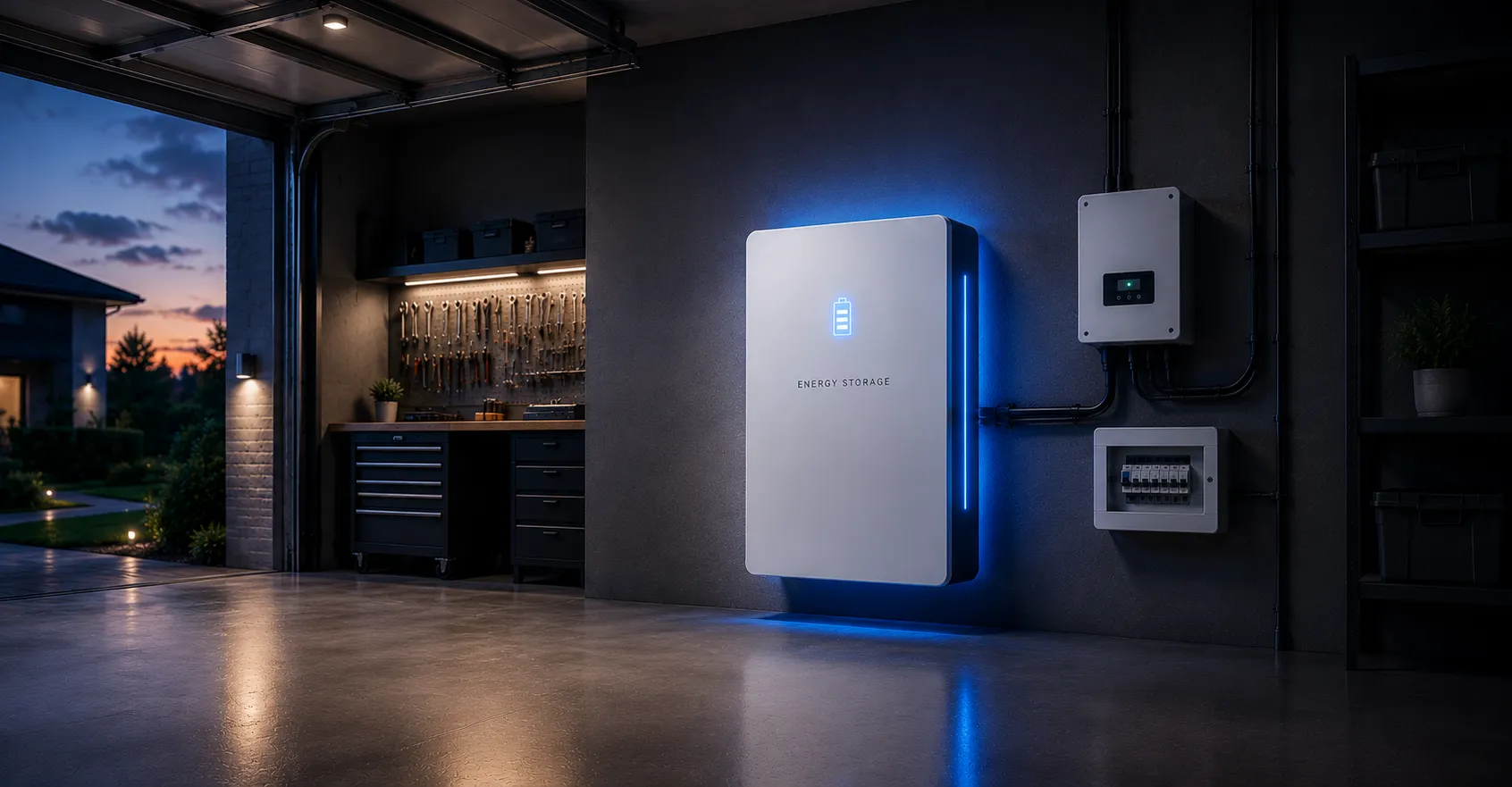
How Home Battery Storage Actually Works
A home battery does one thing: it stores electricity for later use. During the day, your solar panels often produce more power than your house needs — that surplus normally gets sent to the grid. A battery captures it instead, holding it until you need it after dark, during a storm, or when grid rates spike.
The system runs automatically. You don't flip any switches. A battery management system (BMS) monitors your home's power consumption and solar production in real time, deciding when to store, when to discharge, and when to pull from or push to the grid — all without any input from you.
The Three Operating Modes
Charging
Solar production exceeds home usage. Surplus flows into the battery instead of to the grid. Happens automatically midday on sunny days.
Discharging
Sun goes down or grid fails. Battery seamlessly supplies your home. Switchover takes under 20 milliseconds — your devices never notice.
Optimization
Smart software tracks time-of-use rates. Charges when electricity is cheap, discharges during expensive peak hours to maximize savings.
Modern systems also learn your household's usage patterns over time. If your utility charges peak rates from 4–9 PM, the battery software will automatically hold charge through those hours regardless of solar production, then recharge overnight when rates drop.
What Home Battery Storage Actually Does for You
Reliable Backup Power
The most common reason homeowners add a battery is backup power. According to EIA data, the average American household experienced over 8 hours of power interruptions in 2023 — up from under 4 hours in the early 2000s. Aging grid infrastructure, severe weather, and wildfire-related shutoffs are all increasing.
A 13–15 kWh battery can power your home's essential loads for 12–24 hours. With solar panels recharging the battery each day, you can maintain power through extended outages of any length — something a gas generator can't do without constant refueling.
What a battery keeps running during an outage:
- Refrigerator and freezer (saves hundreds in spoiled food)
- Medical devices — CPAP, oxygen concentrators, insulin refrigeration
- WiFi router and phone chargers
- Lights and ceiling fans
- Security cameras and alarm systems
- Select outlets for work-from-home essentials
Lower Bills Through Rate Arbitrage
In states with time-of-use (TOU) electricity pricing — California, New York, Arizona, Texas, and others — rates during peak hours (typically 4–9 PM) can be 2–4x the off-peak rate. A battery charges during cheap hours and discharges during expensive ones.
In California specifically, where peak rates can exceed $0.55/kWh, a well-configured battery can save $800–$1,500 per year in bill reductions alone. Over a 10-year battery lifespan, that's $8,000–$15,000 in savings — offsetting most or all of the system cost before any backup power value is counted.
Protection from Rising Rates
US electricity rates have increased an average of 3–4% per year for the past decade. A solar-plus-battery system locks in a large portion of your electricity cost at zero — the cost of your panels and battery, already paid. Every rate increase the utility imposes makes your system more valuable relative to grid power.
Real Battery Storage Costs in 2026
Battery prices have dropped significantly over the past five years. Here are real installed cost ranges for the most popular home systems in 2026 — including equipment, labor, electrical work, and permits:
What About Incentives?
The federal 30% ITC expired for residential solar on December 31, 2025 — but the rules for standalone batteries are more nuanced. Batteries installed alongside new solar systems in 2026 may still qualify for credits under specific state programs.
More importantly, several state-level battery incentives remain active and are substantial:
- California SGIP: Self-Generation Incentive Program — up to $1,000+ per kWh for qualifying storage in high fire risk areas
- New York: Con Edison and National Grid battery incentives of $200–$500/kWh
- Maryland: Residential Clean Energy Storage Grant of up to $5,000
- Vermont: Green Mountain Power battery programs with significant incentives
See our full Battery Incentives Guide for what's available in your state.
How to Size a Home Battery System
The right battery size depends on what you want to accomplish. These are the three most common goals and what they require:
Goal: Cover Nighttime Usage
A typical home uses 1–2 kWh per hour in the evening. For 8 hours of overnight coverage, you need 8–16 kWh of usable capacity. One Tesla Powerwall 3 handles most households.
Goal: Backup Essentials During Outages
Refrigerator, lights, WiFi, phone charging, and a TV use roughly 0.5–0.8 kWh/hour. A 13.5 kWh battery provides 16–27 hours of essential backup.
Goal: Full Home Backup / Off-Grid Capability
Running HVAC, water heater, and all appliances requires significantly more storage. Typically 20–40 kWh minimum, often combined with a generator for extended cloudy periods.
Use our Battery Sizing Calculator to get a personalized recommendation based on your home's energy use and goals.
Battery Lifespan and Maintenance
Modern lithium iron phosphate (LFP) batteries — the chemistry used in most residential systems — are rated for 3,000–6,000 charge cycles. At one cycle per day, that's 8–16 years of operation. Most manufacturers back this with a 10-year warranty guaranteeing at least 70% of original capacity at end of warranty.
Unlike gas generators, home batteries require essentially no maintenance:
- No oil changes, fuel refills, or filter replacements
- No annual service calls required
- Software updates happen automatically via WiFi
- Monitor performance through your manufacturer's app
- Keep ventilation adequate around the unit (most are rated for garage or utility room installation)
The main thing to watch is your monitoring app — a sudden drop in capacity or unexpected discharge patterns is your signal to contact your installer. Most issues are software-related and resolved remotely.
Is Home Battery Storage Worth It in 2026?
The honest answer: it depends on your situation. Battery storage makes strong financial sense if at least two of these apply to you:
- ✓ You're in a time-of-use rate market (California, New York, Arizona, etc.)
- ✓ Your area has experienced multiple multi-hour outages in the past two years
- ✓ You have or are adding solar panels
- ✓ You qualify for a state battery incentive that reduces cost by 20%+
- ✓ You have medical equipment that requires reliable power
- ✓ You work from home and power interruptions cause significant income loss
If only one of these applies, a battery may still be worth it — but the payback period will be longer and the case is more about peace of mind than pure financial return.
Battery Storage FAQs
Do I need solar panels to get a home battery?
No. A standalone battery (not connected to solar) can still save money in time-of-use markets by charging from the grid at off-peak rates and discharging during expensive peak hours. However, the savings are smaller without solar generation, and you lose the outage resilience benefit since the battery can't recharge itself when the grid is down. Most homeowners add storage as part of a solar installation.
How long does installation take?
The physical installation takes 4–8 hours for a single battery — typically one day. The permit and utility approval process takes longer: expect 2–6 weeks depending on your municipality and utility. Plan for the full timeline when setting expectations for when your system will be operational.
Can a battery power my whole house during an outage?
Typically not indefinitely for a whole home. A 13.5 kWh battery can power all of a home's essential loads (refrigerator, lights, WiFi, phone charging) for 12–24 hours. Running central air conditioning, electric water heaters, or EV charging simultaneously will drain the battery in 2–6 hours. Proper load management — which your installer can help you configure — is key to maximizing backup duration.
What's the difference between AC-coupled and DC-coupled batteries?
DC-coupled batteries connect directly to your solar panels before the inverter — more efficient (95%+ round-trip) but requires a compatible inverter. AC-coupled batteries connect after the inverter and work with any solar system — easier to add to existing installations but slightly less efficient (88–92% round-trip). For most homeowners, the practical difference in annual performance is minor. Your installer will recommend the right configuration for your setup.
Are home batteries safe?
Yes. Modern lithium iron phosphate (LFP) batteries — used in Powerwall 3, Enphase, and most residential systems — are significantly more thermally stable than the lithium cobalt oxide chemistry used in older laptop batteries. They don't require ventilation beyond normal airflow, can be installed indoors or in garages, and are listed to UL 9540 safety standards. Fire incidents with properly installed residential batteries are extremely rare.
Find out what battery size your home actually needs.
Use the Battery Sizing Calculator →